
The Architecture
No AI decides anything about your candidates
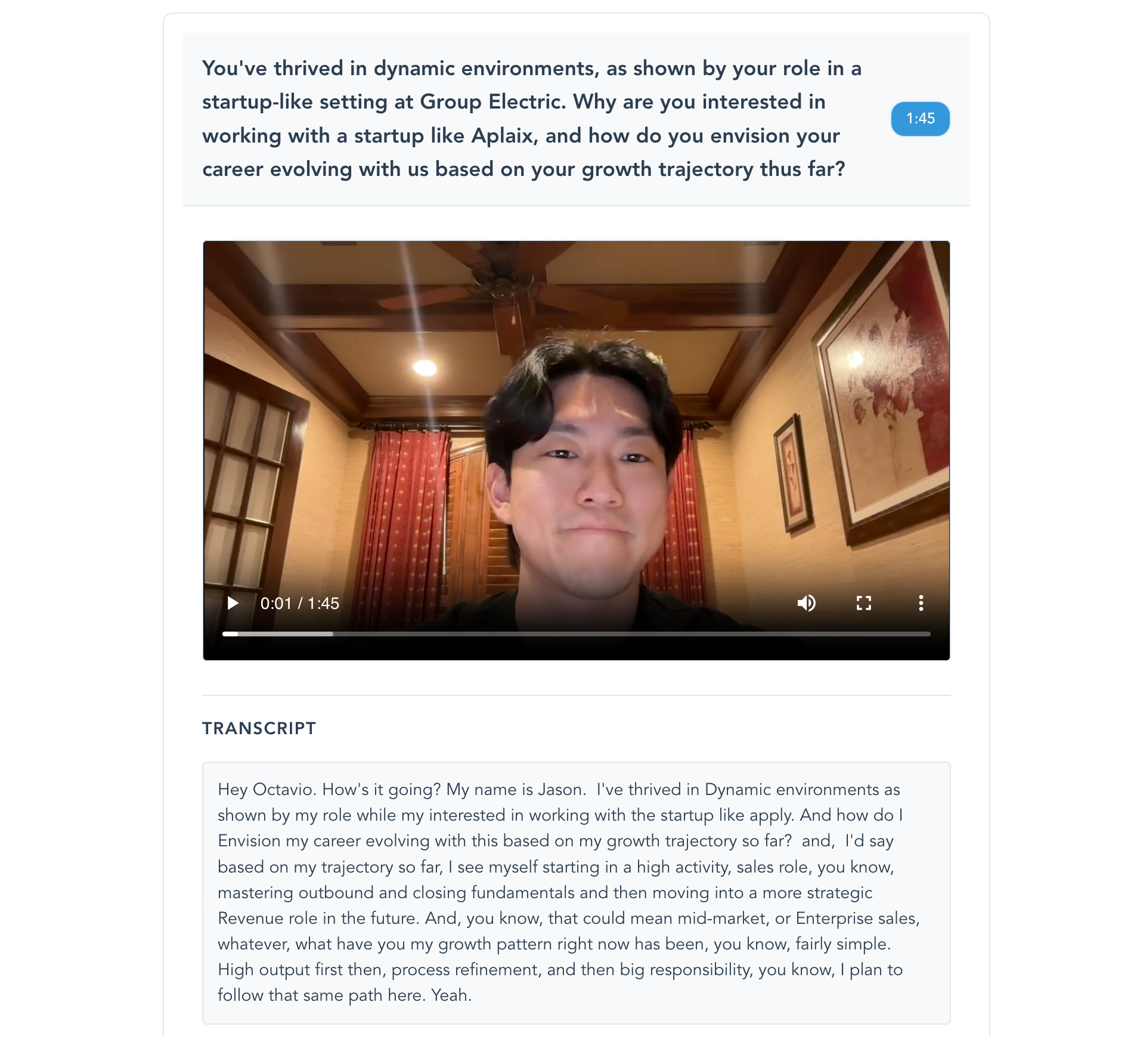
Here's exactly what the AI sees: the text transcript of a candidate's answers, their resume, and the text of the role. That's it. It returns strengths and weaknesses against that role, as reading material for a recruiter — nothing else.
No Facial Analysis
Never scans expressions or body language.
No Voice/Tone Scoring
Ignores accents, stammers, or nervousness.
No Automated Rejections
AI never passes or fails a candidate.
The direct consequence: a nervous candidate isn't penalized for being nervous. Only what they said gets read.
The Filter
The filter is effort, not algorithm
Completing an async video submission takes deliberate human work — spray-and-pray applicants and bots won't do it. That effort is the screen. The population self-selects before anything or anyone scores it.
The assessment is generated as soon as a submission comes in, not when a recruiter opens it — but generating an assessment isn't deciding. The AI never advances or rejects anyone; that action doesn't exist anywhere in the product.
Who Decides
The recruiter decides. Always.
The assessment is an input a human reads, never a gate. A recruiter chooses to review a candidate, reads the transcript alongside the AI's notes, and makes the call. Nothing upstream of that decision has already decided it for them.
Where AI sits
Reading the transcript, resume, and role text after a candidate has already passed the effort-based filter — and handing a recruiter strengths and weaknesses to read.
Where it doesn't
It doesn't score, rank, advance, or reject anyone. It doesn't touch video or audio. It doesn't get a vote.
Structure, Not A Bias Claim
Why structure is fairer than what it replaces
Every candidate answers the same questions, under the same conditions, evaluated on what they said rather than how they said it — the direct payoff of the transcript-only architecture above.
Compare that to the unstructured phone screen it replaces: the interviewer's mood, the time of day, how the small talk went — all of it moves the outcome before a single skills question gets asked.
We're not claiming this eliminates bias. We're claiming something narrower and defensible: structure, consistency, and evaluation on content instead of delivery.
See exactly what the AI sees.
Post a role and read the same transcript-only assessment your recruiters would.
Start FreeNo credit card needed